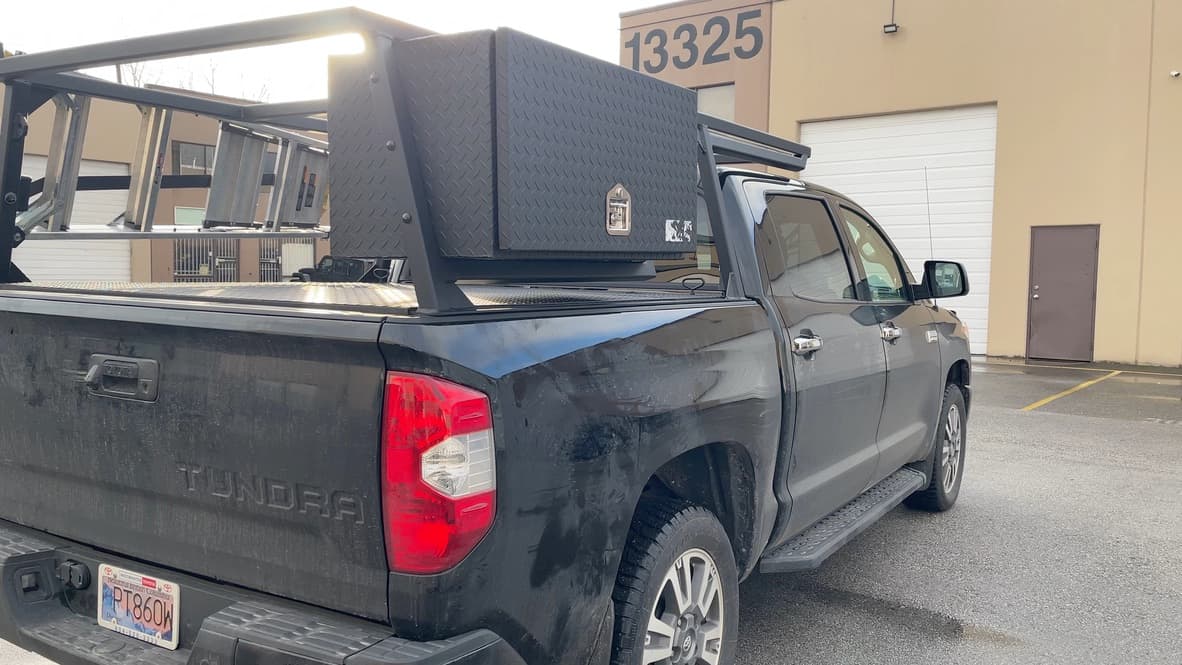
The best truck rack for a contractor depends on what you carry, how often you load it and which parts of your truck you need to access throughout the day.
There is no single rack configuration that is best for every trade.
An electrician carrying ladders and conduit may need a lightweight ladder rack with clear bed access. A plumber carrying long pipe may benefit from full-length support and secure tie-down points. An HVAC contractor may need a rack that works around toolboxes and bulky equipment, while a general contractor may need the flexibility to carry lumber, ladders and changing materials from one project to the next.
For most commercial users, the best setup is therefore a rack designed around the vehicle and the actual workflow rather than a generic one-size-fits-all system.
Here is the quick comparison:
| Trade | Most Useful Rack Style | Important Features |
|---|---|---|
| Electrician | Ladder / contractor rack | Ladder support, conduit storage, bed access |
| Plumber | Full-length or ladder rack | Pipe support, tie-down points, long cargo capacity |
| HVAC | Contractor / custom work rack | Toolbox access, equipment clearance, modular storage |
| General contractor | Full-length contractor rack | Lumber and ladder support, flexibility, multiple crossbars |
| Roofer | Ladder / full-length rack | Long ladder support, easy loading |
| Landscaper | Custom work rack | Tool organization, bed access, equipment separation |
| Glazier | Specialized glass rack | Secure glass transportation |
| Traffic-control crew | Traffic-control rack | Organized sign, cone and tripod storage |
If your truck is part of your business every day, choosing the correct rack should begin with what your crew carries, not simply which rack looks strongest.
Ridge Rack designs and fabricates custom truck racks in Surrey for contractors and commercial vehicles throughout Vancouver and the Lower Mainland.
What Makes a Good Contractor Truck Rack?
A work truck rack needs to do more than hold cargo. A useful contractor rack should help you:
- Carry long materials safely and practically
- Keep the truck bed available for tools and equipment
- Load and unload without unnecessary steps
- Preserve access to toolboxes and storage
- Use available payload efficiently
- Secure cargo at appropriate locations
- Adapt to the type of work you perform
- Withstand frequent commercial use
- Work with the dimensions and configuration of your truck
For a truck that works five or six days a week, small design details can have a significant impact. If you must remove equipment every time you need access to a toolbox, climb into the bed repeatedly to retrieve materials or rearrange cargo throughout the day, the rack may technically carry your equipment without actually improving your workflow.
The right rack should make the truck easier to work from.

Best Truck Rack for Electricians
For many electricians, a ladder rack or lightweight full-length contractor rack is the most practical choice. Common electrical cargo includes:
- Extension ladders
- Step ladders
- Conduit
- Cable trays
- Long tools
- Toolboxes
- Electrical supplies
Because many of these items are long rather than extremely heavy, electricians often benefit from moving ladders and conduit above the bed while keeping the truck bed available for tools and materials.
Features Electricians Should Consider
Multiple support points
Long conduit and ladders should have sufficient support rather than being balanced across only a small portion of the truck.
Cargo stops
Stops can help prevent ladders, conduit and similar materials from shifting sideways.
Accessible tie-down locations
Frequent loading means tie-down points should be positioned where workers can reach them easily.
Toolbox clearance
If a cross-bed or side toolbox is installed, the rack should not prevent its lid or compartments from opening.
Lightweight construction
Keeping unnecessary rack weight down preserves more of the vehicle’s available payload for equipment and materials.
For many electrical contractors, aluminum is worth considering because it combines relatively low weight with corrosion resistance.

Best Truck Rack for Plumbers
Plumbers frequently transport some of the longest materials carried by tradespeople.
Depending on the business, that can include:
- PVC pipe
- Copper pipe
- ABS pipe
- PEX
- Ladders
- Threading equipment
- Drain-cleaning equipment
- Toolboxes
- Fittings and supplies
For that reason, a long ladder rack or full-length custom truck rack can be especially useful.
Instead of placing long pipe diagonally across the bed or allowing it to extend unsupported, a properly configured rack creates multiple support points along the vehicle.
For businesses regularly carrying particularly long materials, a full custom bumper-to-bumper rack may provide additional usable support length.
What Plumbers Should Prioritize
Look for:
- Adequate rack length
- Multiple crossbars
- Convenient rear loading
- Secure tie-down locations
- Cargo stops
- Toolbox compatibility
- Clear access to the truck bed
- Appropriate load capacity
If multiple pipe types are transported at the same time, it may also be worth discussing whether the rack can be divided or configured to keep materials easier to organize.

Best Truck Rack for HVAC Contractors
HVAC vehicles have a different challenge.
Technicians may carry:
- Extension ladders
- Refrigerant
- Ducting
- Pipe
- Toolboxes
- Diagnostic equipment
- Installation supplies
- Replacement parts
- Occasionally bulky HVAC equipment
Because the truck may contain both long cargo and valuable tools, storage access is especially important.
A rack that carries a ladder perfectly but blocks your toolbox is not a good HVAC rack.
For HVAC contractors, a custom contractor rack that works around existing storage usually makes more sense than choosing the rack separately and trying to fit everything else around it later.
Useful HVAC Rack Features
Consider:
- Ladder support
- Clear toolbox openings
- Bed accessibility
- Tie-down locations
- Removable components
- Side loading where useful
- Space for future storage upgrades
- Compatibility with existing equipment
If a toolbox is part of the setup, Ridge Rack also provides truck toolbox installation.
Planning the toolbox and rack together can help avoid clearance problems later.
Best Truck Rack for General Contractors and Construction
General contractors probably need the most flexible configuration because their cargo can change dramatically from one project to another.
On Monday, the truck may carry ladders.
On Tuesday:
- Lumber
- Framing materials
- Pipe
- Long trim
- Scaffolding components
- Tools
- Construction equipment
That makes a full-length contractor rack with several usable support points particularly valuable.
Instead of optimizing the rack for one specific material, the goal should be creating a platform capable of supporting many different jobs.
Construction Contractors Should Look For
Multiple crossbars
Additional support positions make it easier to carry materials of different lengths.
Accessible tie-down points
Cargo changes constantly on construction vehicles, so securement flexibility matters.
Long-cargo capability
Lumber, ladders and other construction materials can extend beyond the truck bed.
Strong but weight-conscious construction
A rack should support the intended work without consuming unnecessary vehicle payload.
Unobstructed bed access
Contractors still need room for tools, saws, fasteners and jobsite equipment.
For businesses carrying long or high-volume materials regularly, consider whether a bumper-to-bumper rack would provide a more useful working platform.

What About Roofers?
Roofers frequently carry long ladders, making loading convenience and ladder support especially important.
A suitable roofing contractor rack should provide:
- Multiple ladder support points
- Accessible loading height
- Effective tie-down locations
- Side stops where appropriate
- Sufficient rack length
- Bed access for tools and materials
If more than one ladder is carried regularly, tell the fabricator approximately how many ladders and what sizes you normally transport.
Designing for your actual cargo is better than discovering after fabrication that the rack is too narrow or inconvenient for the equipment used every day.
What About Landscapers?
Landscaping trucks often need to balance long tools with bulky equipment.
Depending on the business, the vehicle may carry:
- Rakes
- Shovels
- Trimmers
- Ladders
- Lumber
- Irrigation pipe
- Toolboxes
- Fuel cans
- Landscaping supplies
A custom rack can help move longer items away from the main cargo area while preserving useful bed space.
The most important question is usually:
Which equipment needs to remain immediately accessible?
The rack should be designed around that workflow.

What About Traffic-Control Contractors?
Traffic-control vehicles have more specialized requirements.
Crews may need to transport:
- Traffic signs
- Tripods
- Cones
- Barricade equipment
- Safety equipment
- Tools
A generic ladder rack does little to organize those items.
For this application, a purpose-built traffic control rack can provide dedicated storage areas that make equipment easier to organize and access.
Ridge Rack’s traffic-control systems are custom-built around the truck and crew requirements rather than using a universal rack configuration.

What About Glaziers?
Glass transportation is another application where a generic contractor rack may not be appropriate.
Glass requires specialized support and securement.
Ridge Rack provides dedicated truck and van glass-rack solutions for businesses transporting glass rather than attempting to adapt a standard ladder rack to a specialized load.
For glazing companies, use a rack intended specifically for glass transport.
Ladder Rack vs. Full-Length Rack: Which Is Better for Contractors?
It depends on the cargo.
Choose a ladder rack when:
- Ladders are your primary long cargo
- You occasionally transport lumber or pipe
- You want a relatively simple setup
- Maximum rack length is not necessary
- You want to preserve a straightforward truck configuration
Consider a full-length rack when:
- You frequently carry long materials
- Several support points would be useful
- Your cargo changes from job to job
- The truck is heavily integrated into your daily workflow
- You need more usable rack length
- You want the design integrated with tool storage or other equipment
Neither is automatically better.
The correct choice is the one that fits the work.
Aluminum vs. Steel for a Contractor Truck Rack
Material selection is another common contractor question.
Aluminum Truck Racks
Aluminum offers several advantages for commercial trucks:
- Lower rack weight
- Natural corrosion resistance
- Good strength-to-weight characteristics
- Useful for vehicles carrying equipment every day
Reducing rack weight can help preserve more of the truck’s payload capacity for actual cargo.
Steel Truck Racks
Steel may be suitable when:
- High structural strength is a major design requirement
- Additional rack weight is acceptable
- The application justifies heavier construction
Finish and corrosion protection become important with steel, especially in the wet climate of British Columbia.
Ridge Rack covers this subject in more depth in its guide to steel vs. aluminum heavy-duty truck racks.
How Much Weight Should a Contractor Rack Hold?
Do not choose a rack by looking for the largest capacity number you can find.
Start with what you actually carry.
Make a list of:
- Your heaviest typical cargo
- Your longest typical cargo
- How frequently you transport it
- How the load will be distributed
- What other equipment remains in the truck
Rack capacity and vehicle payload are not the same thing.
The weight of the rack itself, passengers, tools, cargo and accessories all affect the vehicle.
If this is an important consideration for your build, see Ridge Rack’s guide on how much weight a truck rack can hold.
Should Contractors Choose a Custom or Universal Truck Rack?
A universal rack can make sense when:
- Use is occasional
- Cargo requirements are simple
- Vehicle-specific integration is unnecessary
- Budget is the dominant consideration
A custom rack becomes more valuable when:
- The truck is used commercially every day
- Toolboxes must remain accessible
- Materials have unusual dimensions
- Specialized loading is required
- Long cargo is common
- Existing equipment affects fitment
- The vehicle has a specialized role
- Workflow efficiency matters
The difference is straightforward:
A universal rack asks your workflow to adapt to the rack.
A custom rack can be designed to adapt to your workflow.
Should a Contractor Rack Work With a Toolbox?
For many trades, yes.
A work truck often needs both external cargo capacity and secure tool storage.
The important part is making sure the two systems do not interfere with each other.
Before rack fabrication, check:
- Toolbox lid clearance
- Side-box door clearance
- Crossbar position
- Mounting locations
- Bed access
- Tailgate access
- Loading direction
If a toolbox will eventually be added, mention that during rack design even if you are not installing it immediately.
Can a Contractor Rack Work With a Tonneau Cover?
Sometimes.
Compatibility depends on the tonneau-cover design and rack mounting method.
Roll-up, folding, retractable and hinged covers all require different clearance.
If your truck already has a tonneau cover, show the fabricator how it opens and where its rails and hardware are mounted.
Do not assume compatibility simply because both accessories are advertised for your truck model.
What Should You Tell a Fabricator Before Ordering?
For contractors, the quality of the final rack depends heavily on how accurately the work requirements are communicated.
Before requesting a quote, prepare:
- Truck year
- Make
- Model
- Bed length
- Photos of the vehicle
- Existing toolboxes
- Tonneau cover or canopy details
- Longest material normally carried
- Heaviest typical load
- Ladder sizes
- Preferred loading direction
- Accessories you may add later
- Whether parts of the rack should be removable
- How often the truck is used for work
Also explain the problems with your current setup.
For example:
“We have to move the ladder every time we open the toolbox.”
or:
“Our 16-foot material doesn’t have enough support.”
Those details can be more useful than simply saying, “I need a truck rack.”
Contractor Truck Rack FAQ
What is the best truck rack for contractors?
There is no single best rack for every contractor. The ideal rack depends on trade, cargo length, cargo weight, loading frequency, truck configuration, tool storage and required bed access.
What is the best truck rack for an electrician?
A lightweight ladder or contractor rack is often suitable because electricians commonly carry ladders and conduit while needing bed space for tools and supplies.
What is the best truck rack for plumbers?
A ladder rack or full-length custom rack can be useful for long pipe, ladders and similar materials. Adequate length and multiple support points are particularly important.
What is the best truck rack for HVAC technicians?
A custom contractor rack that preserves toolbox and equipment access is often the most practical configuration.
What rack is best for construction?
General contractors often benefit from a versatile full-length rack with several support points because cargo can vary between ladders, lumber, pipe and other construction materials.
Is aluminum or steel better for a work truck rack?
Neither material is automatically best. Aluminum reduces rack weight and resists corrosion, while steel may suit applications where heavier construction is justified. The correct material depends on the design and intended load.
Is a custom truck rack worth it for contractors?
It can be particularly valuable for contractors who use their truck daily and have specific cargo, storage or access requirements that universal racks cannot accommodate efficiently.
Can Ridge Rack build around my existing toolbox?
Custom fabrication can account for existing truck equipment, subject to available space, mounting requirements and the specific vehicle configuration.
Can the rack have removable sections?
Certain custom rack designs can incorporate removable components when appropriate. This should be discussed before fabrication.
Can I carry ladders, pipe and lumber on the same rack?
Potentially, provided the rack and vehicle are designed and rated appropriately for the cargo. The actual materials, dimensions, loads and securement requirements should be considered during design.
Does the truck model affect rack design?
Yes. Bed dimensions, cab height, mounting locations, payload, existing accessories and body configuration can all influence rack design.
How much does a contractor truck rack cost?
Cost varies according to rack size, material, vehicle, configuration, fabrication complexity, accessories, finish and installation. A custom quote is the most accurate way to establish pricing.
Get a Contractor Truck Rack Built Around Your Work
Your truck is more than transportation.
For many contractors, it is a mobile workspace used every day to carry the equipment and materials that make the business possible.
A useful rack should therefore be designed around three things:
Your vehicle. Your cargo. Your workflow.
Whether you are an electrician carrying ladders and conduit, a plumber transporting pipe, an HVAC technician working around tool storage or a contractor hauling different materials every day, Ridge Rack can fabricate a custom rack around the way your truck is actually used.
Ridge Rack designs, fabricates and installs custom truck racks in Surrey and serves commercial vehicle owners throughout Vancouver, Langley, Delta, Burnaby and the Lower Mainland.
or