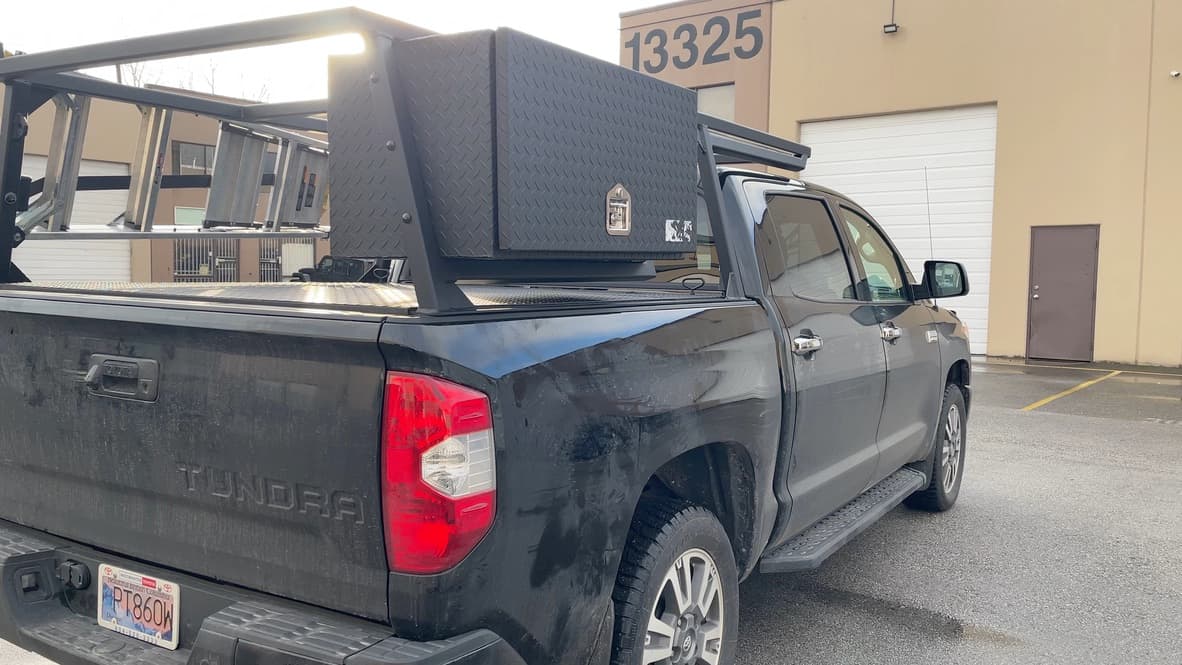
A well-organized traffic control truck should make signs, stands, cones, and other equipment easy to reach without forcing crews to unload or move unrelated gear first. The most effective setup gives frequently used equipment a dedicated position and uses the truck bed or van space according to the order in which the crew loads, transports, and deploys equipment.
For traffic control companies, flagging crews, contractors, and municipal teams, a purpose-built rack can turn a crowded vehicle into a more practical working system. Instead of stacking signs and stands loosely in the truck bed, a custom rack can separate equipment, preserve usable cargo space, and make loading and unloading more efficient.
Ridge Rack designs and installs custom traffic control racks for pickups and commercial vans in Surrey, Metro Vancouver, and the Fraser Valley.
What Does a Good Traffic Control Truck Setup Look Like?
There is no single layout that works for every traffic control vehicle.
A truck carrying a small number of signs and cones for short-duration jobs needs a different setup from a vehicle that regularly transports multiple sign sizes, stands, cones, tools, and additional traffic control equipment.
The best layout begins with the crew’s actual workflow. Equipment that is used at nearly every job should be accessible without unloading less frequently used items. Signs should have dedicated storage that prevents them from becoming mixed together, while stands and cones should be positioned where crews can load and remove them efficiently.
The goal is not simply to fit more equipment onto the vehicle. A good traffic control truck setup should make the available space easier to use.
Start With the Equipment You Carry Every Day
Before choosing a rack, identify what normally travels in the vehicle.
For many traffic control crews, the largest storage challenges are signs, tripods or stands, and traffic cones. These items have very different shapes, so simply stacking them together can waste truck-bed space and make individual items difficult to retrieve.
Signs are relatively flat but can occupy substantial width when they are piled without organization. Tripods and stands are long and irregularly shaped. Cones can consume a large amount of bed space if there is no dedicated location for them.
A rack designed around these different shapes can make better use of the same vehicle.

Give Traffic Signs Their Own Storage Area
Traffic signs should be easy to identify and remove without sorting through an entire stack at the jobsite.
A dedicated sign rack uses separate channels or slots to keep signs upright and organized. The exact spacing and number of sections can be designed around the signs a crew regularly carries.
This becomes particularly useful when several types of signs are transported on the same vehicle. Instead of placing them flat underneath other equipment, crews can keep them visible and accessible.
Ridge Rack’s traffic control systems can be configured with dedicated sign slots based on the vehicle and the equipment being carried.
Keep Stands and Tripods Separate From Signs
Sign stands and tripods should also have a defined storage position.
Placing them loosely between signs, cones, tools, and other equipment can make loading inefficient and consume usable bed space. Dedicated channels allow stands to remain grouped together while leaving other sections of the rack available for signs and equipment.
The layout should consider how the crew works at the jobsite. If signs and stands are typically deployed together, their storage areas should be positioned so both can be accessed without moving unrelated cargo.
That small design decision can make a custom rack considerably more practical in everyday use.
Use Dedicated Space for Traffic Cones
Cones are essential equipment, but they can quickly take over a pickup bed.
A dedicated cone holder allows the vehicle to carry cones without sacrificing as much of the central cargo area. Depending on the vehicle and rack design, cones can be stored vertically or on a separate top-mounted section.
Ridge Rack offers cone rack configurations that can be integrated into a larger traffic control rack rather than treated as a separate accessory.
The right position depends on the number and size of cones being transported, vehicle height, access requirements, and the other equipment carried by the crew.
Organize the Truck Around Loading and Unloading
One of the most important questions when planning a traffic control truck setup is simple:
What does the crew need first when arriving at the jobsite?
The answer should influence the rack design.
If cones are normally deployed first, they should not be trapped behind signs or tools. If particular signs are used repeatedly, they should be accessible without unloading an entire rack. Equipment that is only occasionally needed can occupy less convenient storage areas.
A custom rack can be designed around this sequence instead of forcing the crew to adapt its workflow to a standard rack.
This is one of the main advantages of a fabricated system over a generic storage solution.
Avoid Using the Entire Truck Bed for One Type of Equipment
A common storage problem is allowing one category of equipment to consume most of the usable bed.
For example, stacking cones across the truck bed may work when only cones are being transported, but it can become inefficient when the same truck also needs to carry signs, stands, tools, and other materials.
Vertical and side-mounted storage can free more of the central bed area for additional equipment.
For crews that need a more extensive working system, a custom truck rack can also be designed around other commercial cargo and equipment.
The objective is to make the vehicle function as one integrated work setup rather than a collection of unrelated accessories.
Aluminum Traffic Control Racks for Work Trucks
Material selection also matters for a vehicle that is used every day.
Ridge Rack builds its traffic control racks using aluminum, providing a combination of strength, relatively low weight, and corrosion resistance. This makes aluminum particularly practical for commercial vehicles operating throughout Metro Vancouver and the Fraser Valley, where racks are regularly exposed to rain and changing weather conditions.
Reducing unnecessary rack weight also matters because the vehicle still needs to carry signs, cones, stands, tools, and other equipment.
The rack should therefore provide the required storage and support without adding more material than the application requires.
Pickup Truck vs. Van Traffic Control Setup
Traffic control equipment can be organized in both pickup trucks and commercial vans, but the layout is different.
For a pickup truck, rack sections can make use of the bed, bed rails, and available vertical space. Signs and stands can be kept in dedicated channels while cones are positioned separately.
Inside a van, the priority is often keeping signs and stands upright and organized along the interior while preserving a central area for movement or additional equipment.
The correct solution depends on the vehicle, available dimensions, doors, existing storage, and how equipment needs to be accessed.
For this reason, the vehicle should be considered as part of the rack design rather than selecting a rack independently and trying to make it fit afterward.
Consider Existing Equipment Before Designing the Rack
Commercial vehicles rarely start with an empty bed.
A traffic control truck may already have a toolbox, bed accessories, lights, storage compartments, or other equipment. These components can affect mounting positions and available rack space.
If the truck carries different types of commercial cargo in addition to traffic control equipment, a larger integrated setup may make more sense.
For more complex work vehicles, Ridge Rack also builds full custom bumper-to-bumper rack systems designed around the truck’s overall working layout.
Planning these elements together can help avoid installing one accessory that later interferes with another.
Should You Choose a Standard or Custom Traffic Control Rack?
A standard configuration may work when vehicles carry similar equipment in predictable quantities.
A custom setup becomes more useful when a crew has particular sign sizes, cone quantities, existing accessories, unusual vehicle dimensions, or a specific loading process.
Customization can also account for options such as quick-release components, reflective markings, lockable storage, powder-coated finishes, and compatibility with additional equipment where required.
The important question is not how many features can be added. It is which features make the vehicle easier for that particular crew to use.
Traffic Control Rack Setup for Fleet Vehicles
For companies operating multiple trucks, consistency can also improve organization.
When vehicles performing the same type of work use similar storage layouts, crews do not need to relearn where signs, stands, and cones are located each time they change vehicles.
At the same time, not every fleet vehicle necessarily needs an identical rack. Different trucks may serve different purposes, carry different equipment, or have different body configurations.
A practical fleet setup can standardize the important storage areas while still allowing each rack to be adapted to its vehicle and role.
How Much Does a Traffic Control Truck Rack Cost?
The cost depends on the vehicle and the complexity of the rack.
A relatively simple sign and stand rack will have a different scope from a full traffic control setup that includes cone storage, additional compartments, custom mounting, finishes, and integration with existing truck equipment.
Vehicle size, rack dimensions, material requirements, storage capacity, mounting method, and added features can all affect the final price.
Because traffic control racks are built around the vehicle and required configuration, the best way to determine cost is to review the truck and the equipment that needs to be carried.
Planning a Traffic Control Truck Setup in Surrey or Metro Vancouver?
Before ordering a rack, take photos of your truck and the equipment your crew normally carries. It is also useful to note the approximate number and size of signs, stands, and cones, along with any existing toolbox or truck-bed accessories.
This information makes it easier to design a rack around the real job rather than estimating how the vehicle might be used.
Ridge Rack designs, fabricates, and installs custom traffic control racks for pickups and commercial vans in Surrey, Metro Vancouver, and the Fraser Valley.
Contact Ridge Rack to discuss your vehicle, equipment, and preferred traffic control truck setup.